Insuring Peace
Can livestock insurance prevent violent conflict? Evidence from two decades of droughts in Kenya
With Paul Schaudt · Quarterly Journal of Economics, 2026
The problem
Droughts are one of the major drivers of conflict in Africa — particularly between nomadic pastoralists, who move with their herds in search of water and pasture, and sedentary farmers. When the rains fail, herders must travel further into contested areas, and disputes over scarce resources can turn violent. Climate change is predicted to make droughts, and with them this source of conflict, more frequent.
The idea
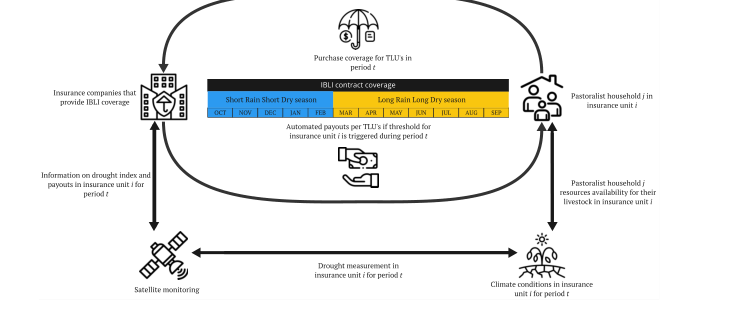
Kenya piloted an unusual policy tool: Index-Based Livestock Insurance (IBLI). Instead of sending assessors to count dead animals, the insurance watches the land itself — satellites measure vegetation and drought conditions, and when the index crosses a threshold, insured pastoralists receive automated, preemptive payouts, before the worst losses hit.
What we find
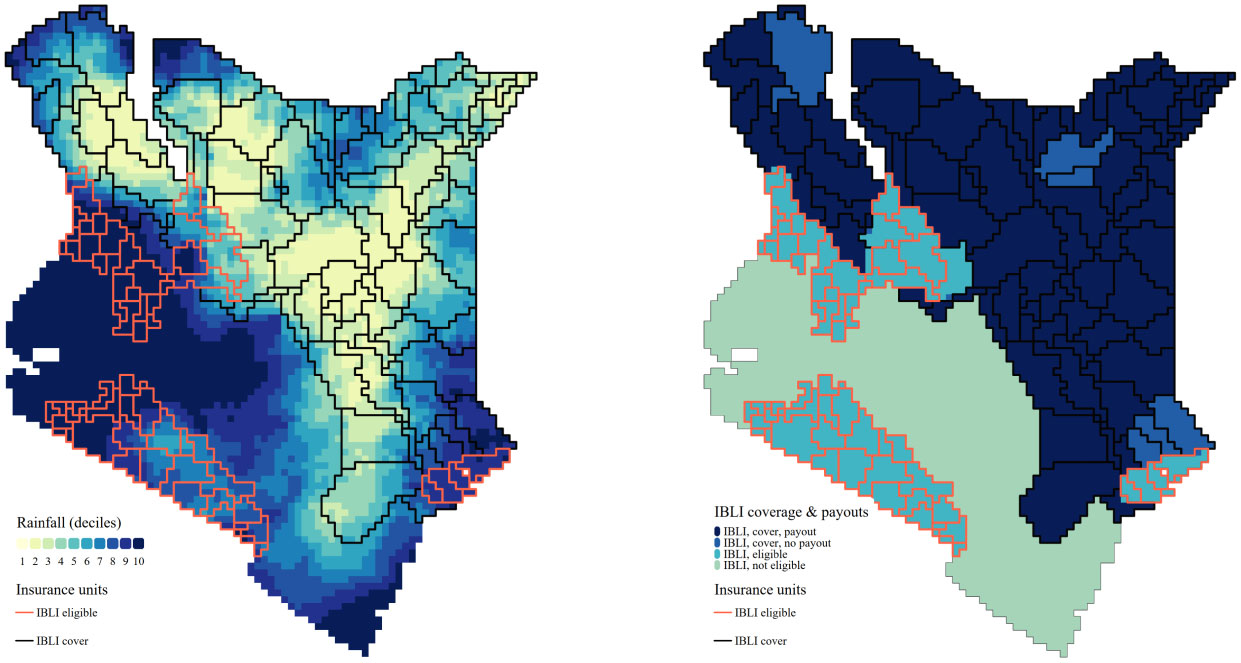
Using the staggered roll-out of IBLI across Kenya (2001–2020) together with quasi-random variation in rainfall, we can compare how the same kind of drought plays out in areas with and without insurance coverage.
Insurance changes the outcome: IBLI strongly reduces drought-induced conflict. A key mechanism is movement — insured pastoralists no longer need to travel as far from their ancestral homelands during droughts, which means fewer encounters and fewer conflicts over scarce resources in contested areas.
Why it matters
Most policy tools against conflict require slow, difficult institutional reform. These results point to a complementary path: market-based instruments — here, insurance — can mitigate conflict at scale, and raise the question of how governments and donors can help underprivileged groups adopt such schemes, for instance through subsidies.
Listen instead (10 min)
An AI-generated audio summary of the paper:
In the media
For researchers
Journal (QJE) | SSRN | Working-paper PDF | Replication data (Harvard Dataverse)
Gehring, Kai, and Paul Schaudt. 2026. “Insuring Peace: Index-Based Livestock Insurance, Droughts, and Conflict.” Quarterly Journal of Economics 141 (2): 1269–1334.